Simplifying AWS VPCs: Your Introductory Guide

Hey, I'm Yash Verma a tech enthusiast with a passion for Linux, Shell Scripting, AWS, CI/CD, Web Dev, and C++. I am a CS Grad with a solid tech foundation.
I have been actively learning DevOps and have progressed a lot. I have hands-on experience with various tools and concepts such as Virtual Machines, EC2, S3, Ansible, Terraform, Jenkins, CI/CD, GitHub Actions, Docker, and more. I have also deployed a Node.js app on AWS EC2 and created several web apps using React, Firebase, and APIs.
I’m eager to dive into fresh tech adventures and share my learnings with the world. Check out my blog posts on Hashnode where I break down complex topics into easy-to-understand bits. Let’s make waves together! 🚀!
Introduction
In the ever-evolving landscape of cloud computing, AWS continues to be a dominant player, offering a plethora of services to meet the diverse needs of businesses. Among these services, Virtual Private Clouds (VPCs) stand out as a fundamental building block for network architecture within the AWS ecosystem. In this article, we'll delve into the world of VPCs, exploring their significance, components, and how they work together seamlessly to ensure secure and efficient network management.
What is a Virtual Private Cloud (VPC)?
Imagine you want to set up a private, secure, and isolated area in the cloud where you can run your applications and store your data. This is where a VPC comes into play.
A VPC is a virtual network that you create in the cloud. It allows you to have your private section of the internet, just like having your network within a larger network. Within this VPC, you can create and manage various resources, such as servers, databases, and storage.
Think of it as having your own little "internet" within the bigger internet. This virtual network is completely isolated from other users' networks, so your data and applications are secure and protected.
Just like a physical network, a VPC has its own set of rules and configurations.
A VPC is a part of the AWS cloud that you can use for your resources. It lets you control your network settings and keep your resources safe and separate. VPCs are scalable and flexible.
Before Deep Diving into the technical terms take an analogy to understand VPC better.
Simplifying VPCs with Real-Life Scenarios
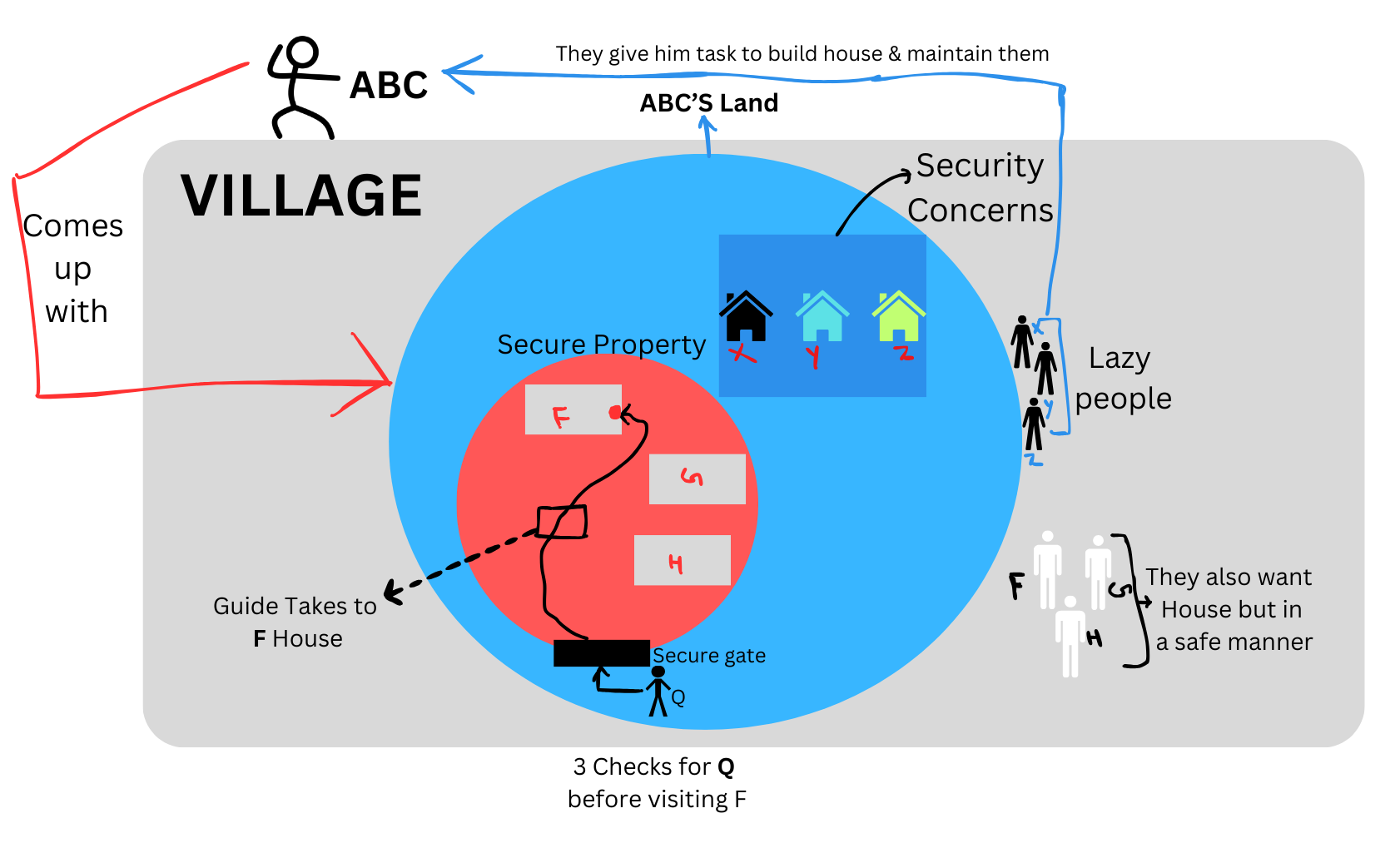
To make the concept of VPCs more accessible, let's draw parallels with a real-life scenario. Imagine a village where 3 individuals X,Y,Z are reluctant or lazy to build and maintain their houses themselves. A wise entrepreneur, "ABC," seizes the opportunity and acquires a huge amount of land to construct houses for these people and promises its maintenance in exchange for money. As he made houses for these 3 very nearby, there is a security issue as all the houses are located close to each other, allowing for potential privacy breaches. Now another 3 People F, G, and H, also want their houses to be built but they told ABC to remove these security concerns which led ABC to create a "secure land" concept.
Inside the secure land, he erects houses for F, G, and H individuals, adding a secure gate that controls access. Only people with proper authorization can enter the secure land and visit specific houses with the help of a guide where he is intended to go. This "secure land" analogy mirrors how AWS VPCs isolate resources, manage security, and control network access within a virtual environment.
SIMILAR TO THIS VILLAGE,
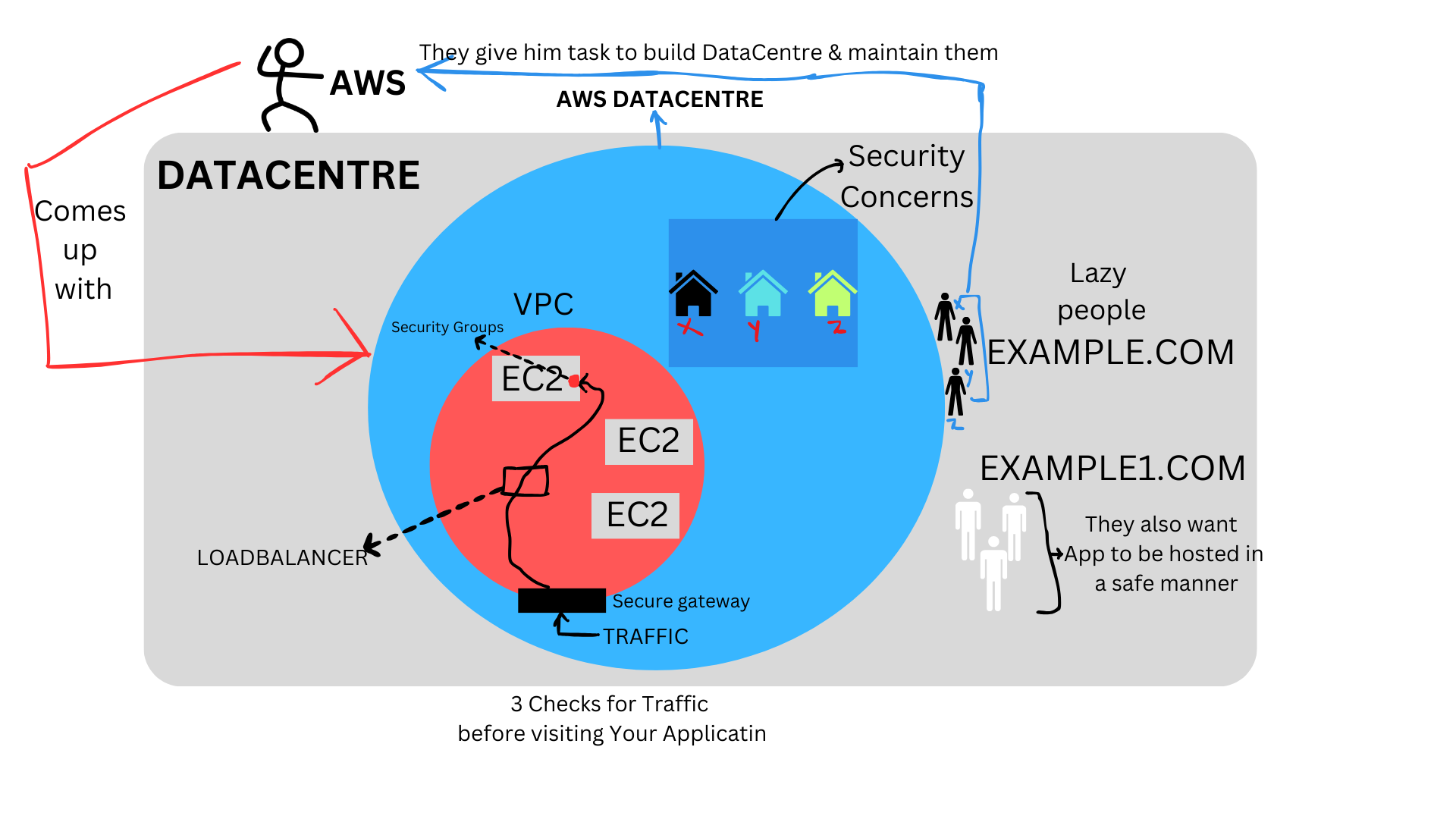
We have AMAZON as the wise entrepreneur here, In the whole Region, some small level Startups like Example.com Do not have So much cost to set up their data centers & maintain them to host their Application. AWS Brought a huge data center and said to Example.com or other Companies that they could Host their Website in their data centers and maintenance would also be taken care of by them. But the issue of security here arises if a hacker enters even 1 Server all other servers hosted on that data center are compromised. So AWS came up with the concept of VPC as a secure Area seen above which has a secure gateway outside for Authentication of traffic coming to the applications. There is a load balancer that guides the traffic to its intended place and there are Security Groups at the application level or Instance level which is the last step of security.
The Components of a VPC
Understanding the key components of a VPC is crucial to harnessing its power effectively. Here are the essential elements:
1. IP Address Range
- When you create a VPC, you specify an IP address range, typically using CIDR notation. This IP address range determines the pool of IP addresses available within your VPC.
2. Subnets
- Subnets are subdivisions of your VPC's IP address range. They enable you to segment your VPC logically. Subnets are associated with availability zones, allowing you to distribute resources across multiple data centers for redundancy and fault tolerance.
3. Routing Tables
- Each subnet in a VPC is associated with a routing table. Routing tables define how traffic should be directed within the VPC. You can customize these tables to control the flow of traffic between subnets and external networks.
4. Security Groups
- Security groups act as virtual firewalls for your AWS resources. They control inbound and outbound traffic to instances in your VPC at the application level. You can define rules to permit or deny specific types of traffic, enhancing security.
5. Network Gateways
- Network gateways, such as Internet Gateways and Virtual Private Gateways, enable connectivity between your VPC and external networks, including the Internet and on-premises data centers.
Interactions within a VPC
The interaction of these components is what makes a VPC a powerful tool for network management:
This is How Traffic from outside flows to our application in VPC's Private Subnet:
There is an Internet gateway (through which the user enters through a public subnet)& there is a Public Subnet inside the VPC through which the request goes to the LoadBalancer. Loadbalancer is assigned to the Public Subnet & further, we will create Target Groups for our Subnet(private). Target group of our application on Instances.
We also create Route Tables which tell our LB the path to reach the Subnet. At the last stage before entering EC2, we have Security Groups which check whether that request has appropriate IP and permissions before entering. In the end, our Traffic successfully goes to the Instance where our APPLICATION is deployed.
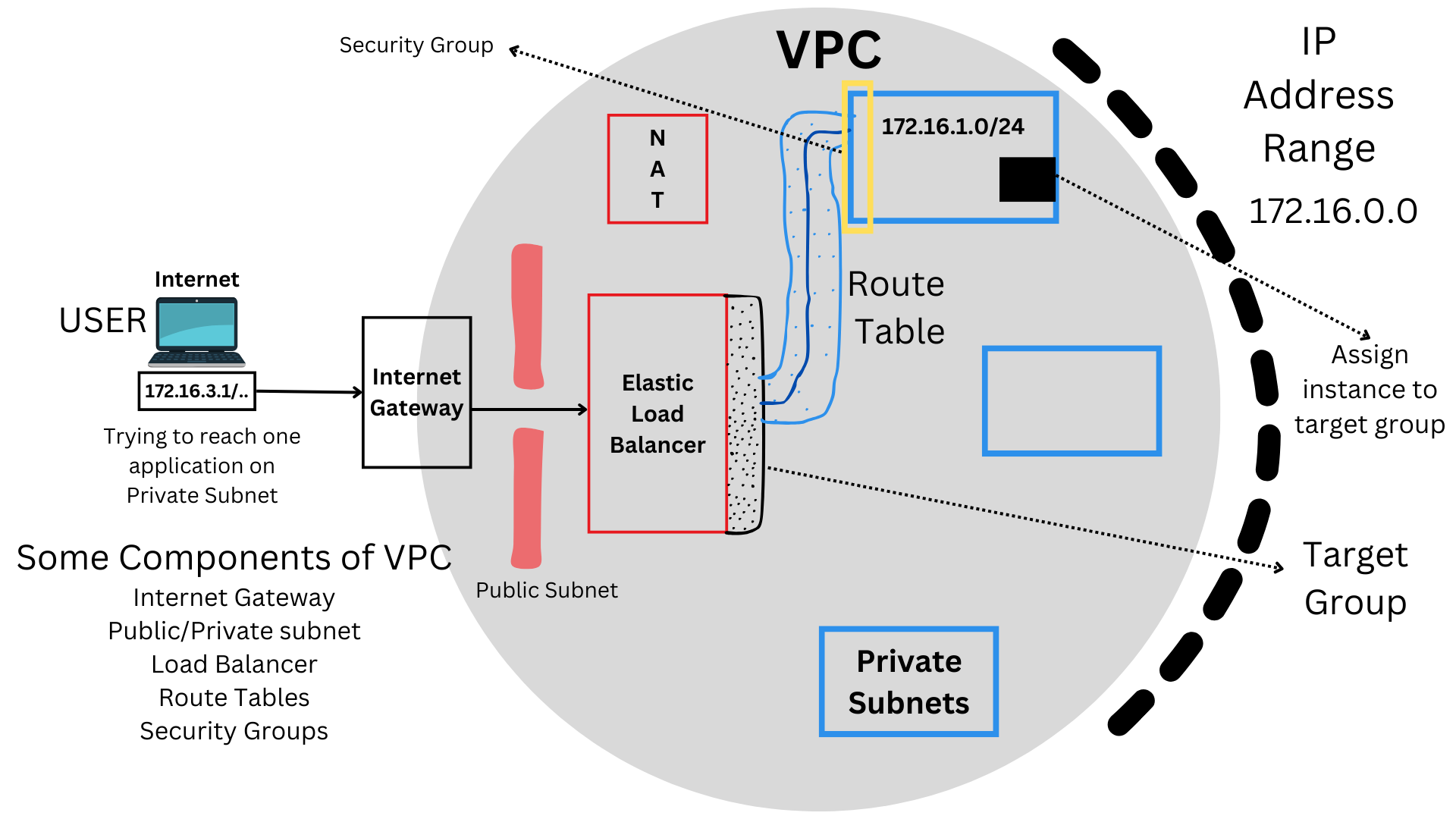
Subnets and Routing Tables: Subnets are associated with routing tables, which determine how traffic flows within the VPC. You can route traffic between subnets or control which subnets can communicate with each other.
Security Groups: Security groups define the rules for incoming and outgoing traffic to instances in the VPC. They add an extra layer of security by allowing or denying specific types of network traffic based on defined rules.
Network Gateways: Network gateways facilitate connectivity between your VPC and external networks. Internet Gateways allow resources in your VPC to connect to the internet, while Virtual Private Gateways enable secure communication with on-premises data centers.
Conclusion
In the world of AWS, Virtual Private Clouds are indispensable for managing network infrastructure securely and efficiently. By understanding the components of a VPC and how they interact, businesses can harness the full potential of cloud computing while maintaining control and security over their network environment. Whether you're a seasoned AWS user or new to networking concepts, VPCs can be decoded and put to work to meet your organization's needs.

That’s it for today; I’m Yash Verma, follow me for simplified tech, DevOps and Cloud-related content.
Happy Coding in the Cloud ☁:)
If you learned from this blog like and share this with your friends.
Connect with me on Linkedin, or Instagram, for any doubts you encounter.


